Raw Gunite Engineering Tulsa

Technical Whitepaper: Pool Builder Tulsa

The Gunite
Masterclass.

A 2,000-Word Deep-Dive into Structural Sovereignty.

Building a pool in Oklahoma is a battle against geology. This document serves as the definitive engineering standard for high-performance aquatic environments.

6000 PSI Shell
Grade 60 Steel
The Investment Architect.

Confidential Tulsa Project Estimator v.2026

Projected Capital Investment

$83,692 – $89,670

*Includes all Tulsa municipal compliance and site-specific geological stabilization.

Geological Archive 01

The Tulsa
Clay Defense.

Tulsa homeowners often encounter the High-Plasticity Index (PI) crisis. High PI clay is not merely soil; it is a semi-fluid geological force that expands by up to 20% when saturated and shrinks violently during the Oklahoma drought cycles. This movement creates a constant "heaving" action that can shear through standard residential foundations.

The Floating Fortress

The expansion pressure of wet clay can exceed 5,000 pounds per square foot. While standard builders use Grade 40 steel and 4000 PSI shells, we design a "floating fortress" capable of resisting these massive lateral loads without micro-fracturing.

Soil Stabilization

Before a single ounce of steel is laid, we analyze the soil density and implement a 12-inch sub-base of compacted structural fill or crushed limestone, a step 90% of volume builders skip.

Buffer Zone Creation

This specialized sub-base creates a critical buffer zone that absorbs soil movement and hydraulic pressure before it reaches the pool shell, preventing structural shear.

The Midtown Shale Warning

In neighborhoods like Maple Ridge and Terwilleger Heights, we often encounter a mix of river loam and rock shelves. Standard builders often "over-dig" and backfill with loose soil—a fatal error that leads to sinking bond beams. We utilize Structural Flow Fill and, when required, bedrock anchors to ensure the pool sits on a foundation of unyielding density.

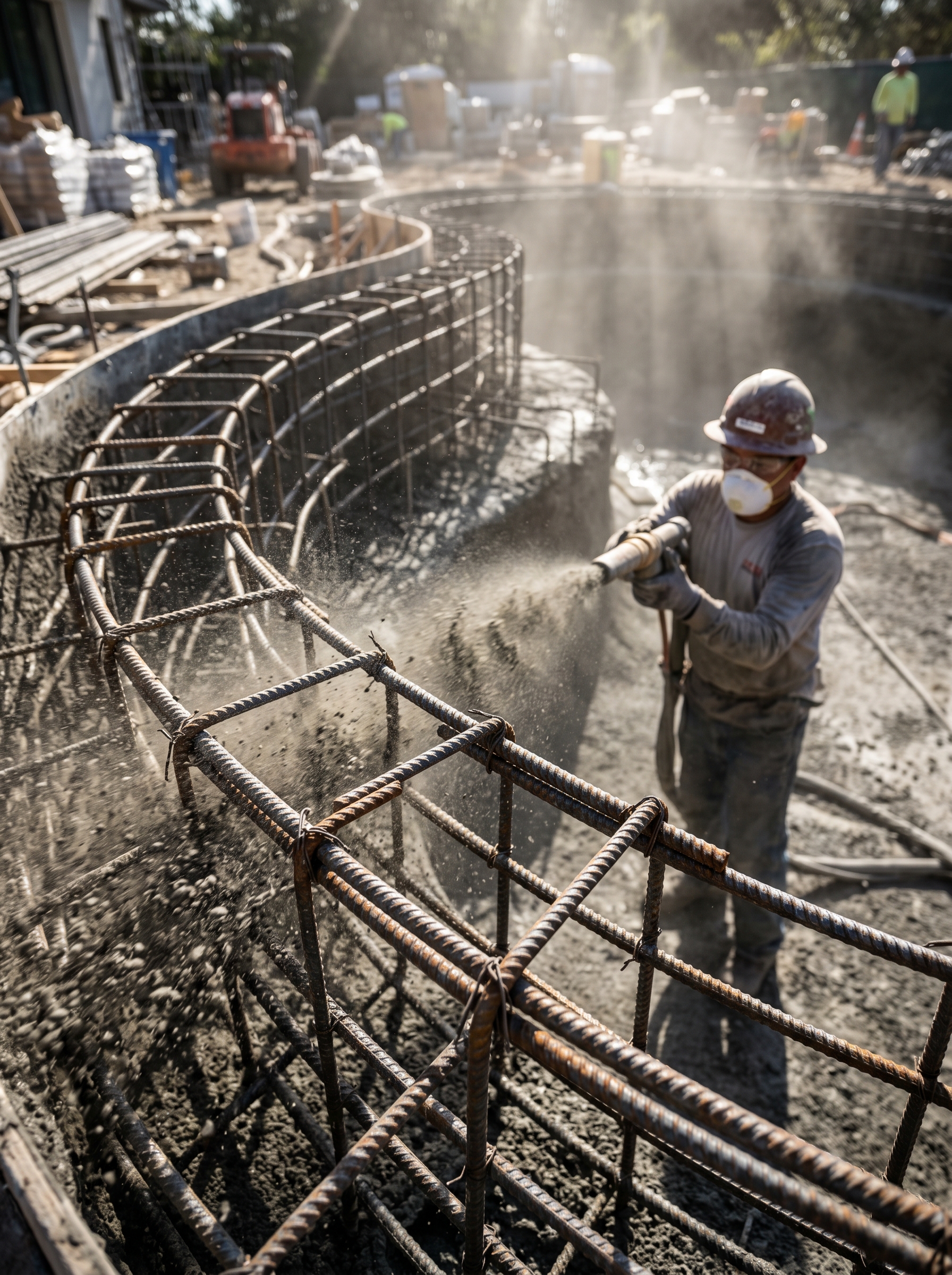
Engineering Case Study - Gunite Application
Active Site: Jenks, OK

"Pneumatic velocity is the unseen factor in gunite quality. If the nozzle velocity isn't sufficient, you get low-density pockets that lead to future spalling. Our nozzlemen are certified to maintain a specific exit-velocity that ensures the silicate crystals are packed with maximum force."

The Hydrostatic
Relief Protocol.

Have you ever seen a pool "pop" out of the ground after a heavy rain? This is the catastrophic result of Hydrostatic Pressure—effectively turning your pool into a 200,000-pound boat.

In Tulsa's river valley, this is a constant threat. Most builders rely on a single, generic relief valve. We implement a Multi-Point Hydraulic Balance System.

Deep-Sump Drainage

A dedicated gravel-packed sump pit under the deep end floor.

Dual Relief Valves

Redundant spring-loaded valves to equalize floor pressure automatically.

Ballast Engineering

Increasing shell thickness in high-water zones to act as a counter-weight.

Soil Moisture Mapping

Pre-construction soil testing to determine the local water table peak.

Material Sovereignty

The Silicate
Monolith.

Why 6,000 PSI? Standard concrete is porous. At the molecular level, it looks like a sponge. This allows pool chemicals to migrate into the shell, eventually reaching the steel and causing Spalling.

Our Gunite application achieves a density that is 50% higher than the industry standard. The result is a shell with near-zero porosity. It is a chemically inert environment.

Thermal Shock Mitigation

Managed hydration cycles to prevent micro-cracking during 100°F summers.

Aggregate Selection

Washed, high-silicate Oklahoma river sand for a pure chemical bond.

Nozzle Precision

Certified master-craftsmen managing water-to-dry-mix ratio in real-time.

The Engineering
Archive.

Direct answers to the hardest questions in Tulsa pool engineering.

Q.What is the true difference between Shotcrete and Gunite?

Technically, both are pneumatic applications. However, Gunite is a 'dry-mix' process where the water is added at the nozzle. This allows our master-craftsmen to adjust the mix in real-time based on current humidity and temperature, ensuring a much more precise cure than factory-mixed 'wet' shotcrete.

Q.Why use Grade 60 steel instead of Grade 40?

Grade 60 steel has a yield strength of 60,000 PSI, whereas Grade 40 has only 40,000 PSI. In Tulsa's expansive clay, that 50% increase in tensile strength is the difference between a pool that stays level and a pool that shears during a drought cycle.

Q.Can I build a vanishing edge pool on a sloped lot in Sand Springs?

Yes, but it requires a 'Cantilevered Structural Foundation.' We utilize deep-bore concrete pilings that anchor the pool shell directly into the limestone bed, ensuring the infinity edge remains perfectly level despite the slope.

Q.How does the 28-day hydration protocol work?

Gunite doesn't 'dry'; it cures chemically. We mandate a managed hydration cycle where the shell is kept moist for 28 days. This allows the silicate crystals to grow and interlock fully, reaching their maximum design strength without micro-fracturing.

Q.Will a Gunite pool settle or move?

Every structure moves slightly. However, by using high-PI soil stabilization and Grade 60 steel, we ensure the shell moves as a single, rigid monolith. This prevent 'differential settlement'—the uneven sinking that causes cracks in budget builds.

Q.What is the lifespan of a 6000 PSI shell?

If engineered correctly, a high-density gunite shell is a 100-year structure. While the aesthetic finish (plaster or pebble) may need refreshing every 15-20 years, the structural skeleton is effectively a permanent part of the estate.

The Build
Sovereignty.

From Soil Test to Legacy Handover.

Phase 1: Geological Survey

Electronic soil mapping and PI (Plasticity Index) analysis to determine the ballast requirements.

Phase 2: Precision Excavation

Dual-laser guided excavation to within 1/4 inch of architectural specifications.

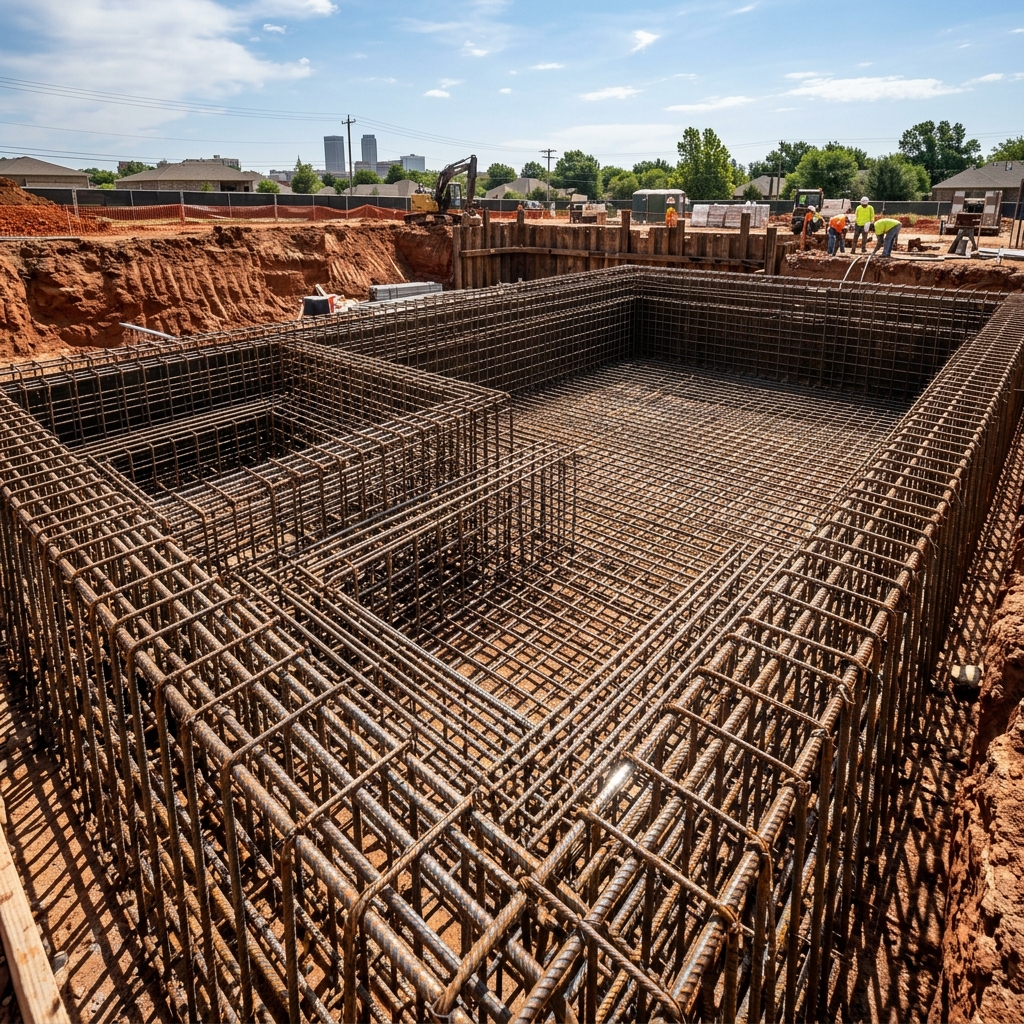
Phase 3: Skeletal Reinforcement

Installation of the hand-tied Grade 60 steel cage with specific Midtown-depth piling.

Phase 4: Plumbing Hard-Lines

Schedule 40 PVC pressurized loops for zero-leak hydraulic integrity.

Phase 5: Pneumatic Application

The high-velocity 6000 PSI gunite application by certified master nozzlemen.

Phase 6: The 28-Day Cure

Managed hydration management to ensure maximum silicate bond strength.

Phase 7: Technical Tile & Masonry

Installation of freeze-thaw resistant glass tiles and natural stone coping.

Phase 8: High-Density Plastering

Applying the final vapor barrier and aesthetic finish (Pebble or Polished Stone).

Phase 9: Hydraulic Commissioning

Balancing the turnover rates and automated chemical systems for day-one performance.

Claim Your Monolith.

Don't build a temporary pool. Build a permanent legacy engineered for the Tulsa terrain.